Getting Started
How to Choose Soccer Equipment for Kids
Learn how to choose kids' soccer cleats, shin guards, socks and the right ball size. Check field conditions and team requirements before buying.
In this article
In this article
Quick Answer
When choosing soccer equipment for kids, focus on four things: cleats suited to the playing surface, properly fitted shin guards and socks, a ball that matches your child's age group, and the team's uniform requirements. Check with the academy about what it expects before buying anything.
Buying soccer equipment for your child can be confusing. There are different types of cleats, shin guards, soccer balls, and uniforms, and it's not always clear what to buy first.
The right choices depend on where your child plays, their age group, and the academy's requirements. Before spending money on a complete set of gear, here's what to look for and what to ask the coach.
1. Choose cleats for the playing surface
Indoor shoes, turf shoes, and outdoor cleats are made for different surfaces, so the right choice depends on where your child will train.
- Indoor shoes: For indoor courts and gym floors.
- Turf shoes: For artificial turf.
- Outdoor cleats: For natural grass fields.
As a general rule, flat, soft-soled shoes (indoor or turf) suit harder, flatter fields, and the surface and weather decide what works best. Before buying, ask the coach what surface your child will play on and whether the academy has specific footwear requirements.
A pair that looks good in the store isn't necessarily the right pair for your child's training ground.
2. Get the right shin guard fit
Shin guards protect your child's lower legs during soccer, but getting the right size matters.
According to the sizing guidance from HealthyChildren.org, shin guards that cover more than three-quarters of the shin are too big. Check the manufacturer's sizing instructions and make sure the guards sit comfortably.
Don't forget the socks. Soccer socks should fully cover the shin guards, so try both together when checking the fit.
Before buying, make sure:
- The guards are the right size for your child's legs.
- They stay comfortably in place.
- The socks cover the guards completely.
Choosing shin guards based only on the age printed on the packaging isn't always enough. Check the actual fit.
3. Pick the right soccer ball size
Soccer balls come in different sizes, and your child doesn't necessarily need an adult-size ball. The correct size depends on their age group and the rules followed by their academy or league.
For example, Hudson Youth Soccer Association uses the following grade-based ball sizes:
| Age group / grade | Ball size |
|---|---|
| Grades 1 to 2 | Size 3 |
| Grades 3 to 4 | Size 4 |
| Grades 5 to 6 | Size 4 |
| Grades 7 to 8 | Size 5 |
| High school | Size 5 |
These are that association's requirements, not a universal rule for every soccer program.
If you're buying a ball for home practice, ask the coach which size your child's group uses. Also follow the manufacturer's inflation instructions and avoid overinflating the ball.
4. Ask about the team uniform before buying
It's tempting to buy a complete uniform the moment your child joins a program. But requirements differ between academies and age groups, and some programs sell club-specific jerseys, shorts, and socks separately, so it's worth waiting until you know yours.
At Gioca Soccer Academy, full kit requirements are shared when a player joins a program. For a first session, players should bring cleats or suitable footwear, shin guards, water, and a ball if they have one. Our guide to what to expect at a first soccer academy training session lists what to bring.
Before ordering a uniform from any program, ask:
- Is a team jersey provided, or do parents buy it?
- Do parents need to buy shorts and socks separately?
- Are there specific colors or designs?
- Is the same uniform used for training and matches?
Checking these details first can save you from buying items you don't need or clothing that doesn't meet team requirements.
What should parents check before buying soccer equipment?
Before buying, take a moment to check what your child's academy expects players to bring. The playing surface, footwear requirements, ball size, and team uniform can all change what you need to purchase.
If your child is new to soccer, our guides on what to expect at a soccer academy trial and getting your child ready for a tryout explain what happens in these sessions and how to prepare.
Let's talk about your child's soccer development
At Gioca Soccer Academy, players train in small groups and receive coach feedback to help them understand their strengths and areas for improvement. Families can start with a free trial session to experience the training environment.
If you're looking for a soccer program for your child, contact Gioca Soccer Academy to start the conversation.
Your questions, answered
What type of cleats should I buy for my child?
It depends on the playing surface. Indoor shoes, turf shoes, and outdoor cleats are designed for different conditions. Check with the coach before choosing a pair.
How do I know if my child's shin guards fit?
Shin guards should fit comfortably. If they cover more than three-quarters of the shin, they are too big. Soccer socks should also cover the guards completely.
What size soccer ball should my child use?
Ball size depends on the age group and league requirements. Check with the academy before purchasing one.
Does my child need a complete soccer uniform?
Not always. Some academies provide certain uniform items, while others require parents to purchase them. Ask what is included before ordering.
Should I buy soccer equipment before the first session?
Check with the academy first. Confirm the footwear, ball, and uniform requirements so you don't purchase items your child may not need.
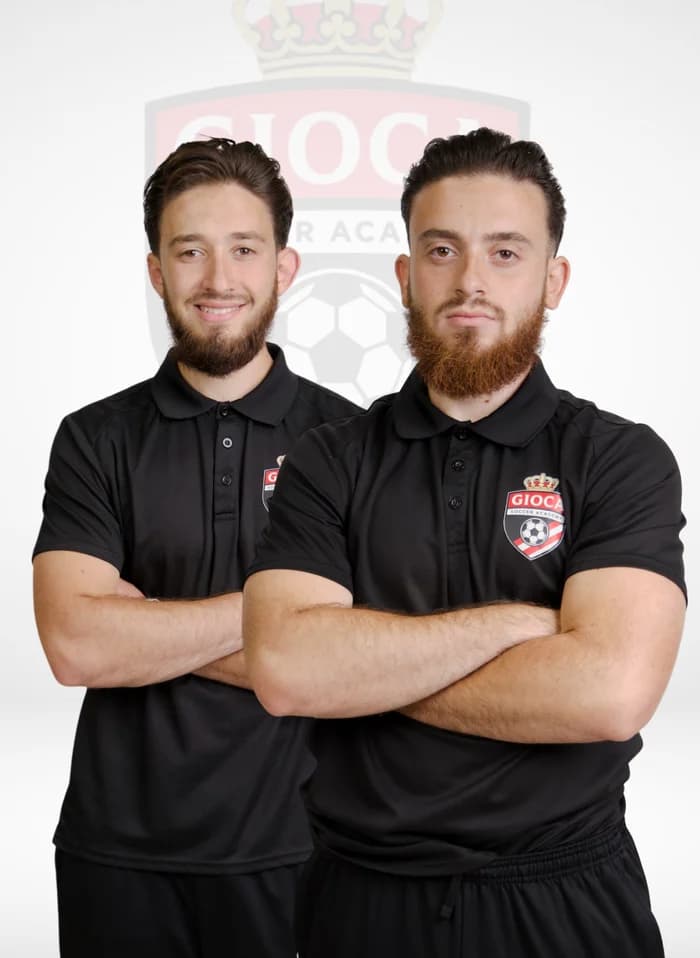
From the Gioca coaching team
Zane and Julian Taha
Meet the people behind the perspective. Our coaches bring a personal approach to every conversation and every session.
Book a Free Session